
NERC CIP Compliance: Azure vs Azure Government
Azure suits most NERC CIP workloads with global reach and faster features; Azure Government provides US-only data residency, physical isolation and screened staff.

Azure and Azure Government both support compliance with NERC CIP standards, but they cater to different needs.
Azure (Commercial) offers global coverage, tools like Azure Key Vault and Microsoft Sentinel, and is suitable for most compliance workloads. Azure Government provides stricter controls, with US-only data storage and personnel access, making it ideal for organisations handling sensitive data like export-controlled information or unclassified nuclear technology.
Key differences:
- Azure: Global availability (60+ regions), logical isolation, and faster access to new features.
- Azure Government: US-only regions, physical isolation, and stricter personnel screening.
Quick Comparison:
| Feature | Azure (Commercial) | Azure Government |
|---|---|---|
| Target Audience | Global organisations | US government and partners |
| Regional Availability | 60+ regions globally | US-only regions |
| Personnel Screening | Standard Microsoft checks | US citizenship required |
| Data Storage | Logical isolation | Physical and logical isolation |
| Best for | General compliance | Export-controlled data |
Choose Azure for broader coverage and flexibility. Opt for Azure Government if you require enhanced security and US-only operations. Both platforms simplify NERC CIP compliance through tools, pre-filled audit worksheets, and automated monitoring.
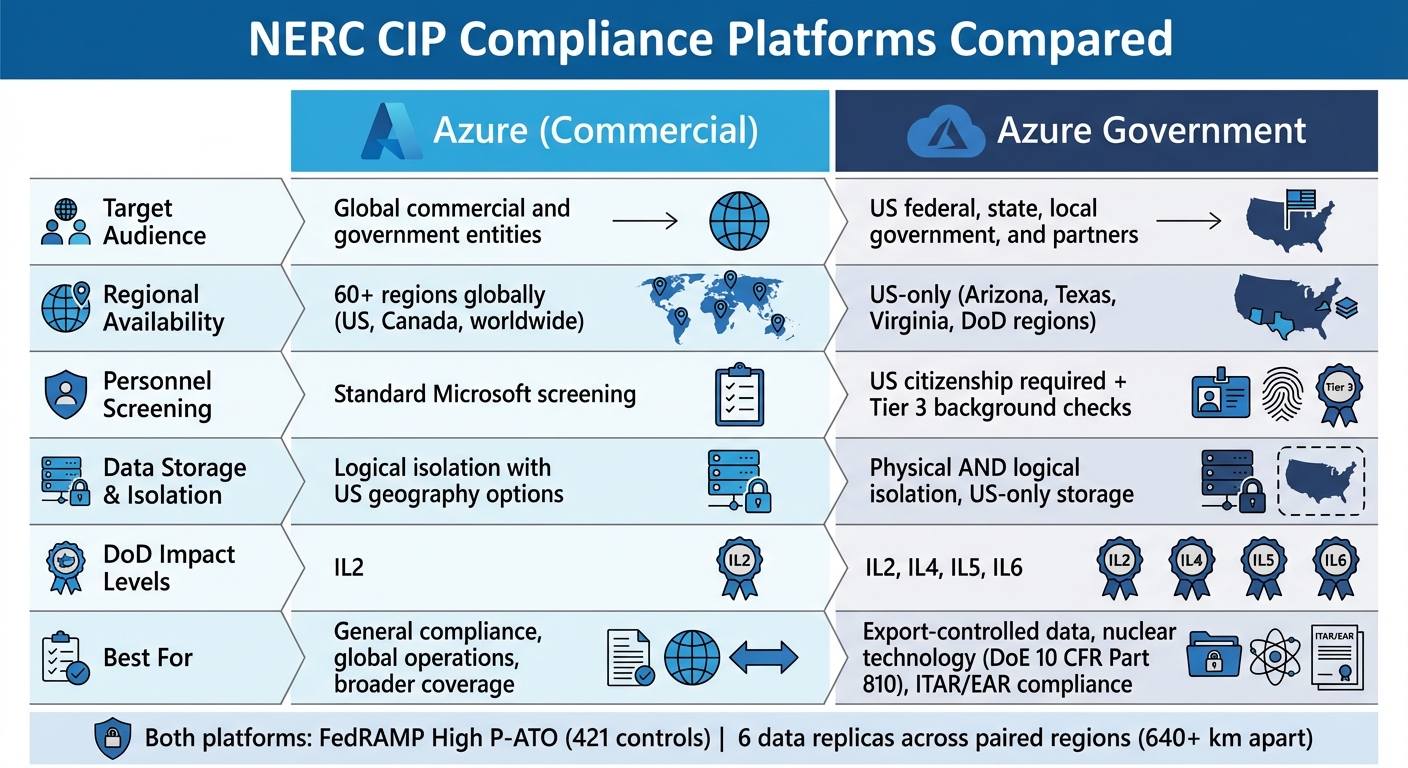
Azure vs Azure Government for NERC CIP Compliance: Key Differences
Looking at Sovereignty Requirements with Azure
Azure for NERC CIP Compliance
Microsoft Azure supports compliance with NERC CIP (North American Electric Reliability Corporation Critical Infrastructure Protection) standards through its FedRAMP High Provisional Authorisation to Operate (P-ATO). This certification, which applies to all U.S. Azure regions, includes 421 controls and control enhancements, addressing most NERC CIP requirements. Utilities can rely on third-party audit evidence, removing the need for separate data centre assessments. Below is an outline of how Azure's tools and global infrastructure help meet these compliance standards.
Azure Compliance Features
Azure’s compliance framework is built on robust tools and processes designed to meet NERC CIP mandates. Using a shared responsibility model, Microsoft secures the infrastructure up to the hypervisor, while customers manage their systems, applications, and data. Key tools aiding NERC CIP compliance include:
- Azure Key Vault: Protects BES Cyber System Information (BCSI) under CIP-011-2 by managing encryption keys through FIPS 140-validated HSMs.
- Microsoft Sentinel: Provides cloud-native SIEM capabilities for incident detection and response, addressing CIP-008 requirements.
- Microsoft Defender for Cloud: Monitors security continuously across hybrid workloads.
"U.S. and Canadian utilities are now free to benefit from cloud computing in Azure for many NERC CIP workloads." - Steve Vandenberg, Principal Global Black Belt, Security, Compliance and Privacy, Microsoft
Azure simplifies audit preparation using its Service Trust Portal, which includes a "Cloud implementation guide for NERC audits." This guide features pre-filled Reliability Standard Audit Worksheets (RSAWs) that map Azure’s controls directly to NERC CIP requirements, reducing the compliance burden on utilities. Additionally, Azure Policy offers built-in regulatory compliance initiatives for FedRAMP High, allowing automated compliance tracking across cloud environments.
To address multi-tenancy concerns, Azure employs a logical isolation architecture. This ensures tenant data and applications remain segregated on shared physical hardware through strict virtualisation controls. This approach combines the cost benefits of cloud computing with security measures suitable for BCSI workloads. Furthermore, geo-redundant storage ensures data resilience with six replicas (three primary and three secondary, located at least 640 km apart).
Regional Availability and Flexibility
Azure operates in over 60 regions worldwide, offering specific benefits for North American utilities through its two Canadian regions in Ontario and Quebec. These Canadian data centres ensure data remains within national borders, meeting residency requirements for Canadian utilities while maintaining the same FedRAMP High controls as U.S. regions. This capability is especially beneficial for utilities operating across both countries, enabling them to use a unified platform while adhering to national data sovereignty laws.
Azure is particularly suited for non-real-time NERC CIP workloads, such as asset management, demand forecasting, SCADA historical systems, and audit evidence collection. These applications fall outside the "15-minute rule" for real-time BES control, making Azure a practical choice for compliance.
Azure Government for NERC CIP Compliance
Azure Government extends Azure's compliance capabilities, offering enhanced physical separation and stricter personnel controls tailored for US-specific workloads. Unlike the standard Azure platform, which uses logical isolation on shared infrastructure, Azure Government operates on dedicated datacentres and networks located exclusively within the United States. This physical isolation provides an extra layer of security for US-based utilities managing sensitive NERC CIP workloads.
Azure Government Features
One of the standout features of Azure Government is its rigorous personnel screening process. All operations staff with access to customer data must pass strict US citizenship verification and Tier 3 background investigations.
"Azure Government provides an extra layer of protection to registered entities through contractual commitments regarding storage of customer data in the United States and limiting potential access to systems processing customer data to screened US persons." – Microsoft
The platform ensures that all customer data is stored within the US and access is restricted to thoroughly vetted US-based personnel. It is designed to meet compliance requirements for ITAR, EAR, and DoE 10 CFR Part 810, which are particularly critical for nuclear electric utilities. Additionally, Microsoft employs Just-in-Time (JIT) access controls, meaning engineers are only granted access to customer data when absolutely necessary, with all activities being logged for transparency.
These robust measures are complemented by Azure Government's extensive certification portfolio, further supporting compliance needs.
FedRAMP High and Other Certifications
Azure Government holds a FedRAMP High Provisional Authorisation, which includes significantly more controls than the FedRAMP Moderate level's 325. These certifications help address NERC CIP audit requirements by providing pre-filled Reliability Standard Audit Worksheets through the Service Trust Portal. The platform also supports Department of Defense (DoD) Impact Levels 4, 5, and even Level 6 (Secret) environments, and has achieved over 400 Moderate and High Authorisations to Operate from various federal agencies.
Additionally, Azure Government's built-in Azure Policy compliance initiatives provide automated monitoring and enforcement across cloud environments. Its geo-redundant storage ensures data resilience by maintaining six replicas across two dedicated US regions, reinforcing both data residency and reliability.
Azure vs Azure Government: Side-by-Side Comparison
Compliance Features Comparison
Choosing the right platform for NERC CIP compliance depends on your specific requirements. Both Azure (Commercial) and Azure Government adhere to FedRAMP High standards, covering 421 controls. However, they differ in areas such as regional availability, personnel screening, and data storage.
| Feature | Azure (Commercial) | Azure Government |
|---|---|---|
| Target Audience | Global commercial and government entities | US federal, state, local government, and partners |
| Regional Availability | 60+ regions (Global, US, Canada) | US-only (Arizona, Texas, Virginia, DoD regions) |
| Personnel Screening | Standard Microsoft screening | Contractual commitment to screened US persons |
| Data Storage | Logical isolation; US geography options | Physical and logical isolation; US-only |
| DoD Impact Levels | IL2 | IL2, IL4, IL5, IL6 |
| NERC CIP Suitability | Suitable for BCSI and certain workloads | Suitable for BCSI and export-controlled workloads |
This table outlines the critical factors for energy utilities aligning their cloud strategies with NERC CIP standards.
Azure (Commercial) provides a global footprint, covering 60+ regions, making it a solid choice for organisations with international operations. However, it doesn't offer the same US-only personnel access guarantees as Azure Government. This distinction is crucial for utilities handling export-controlled data, such as those subject to DOE 10 CFR Part 810 regulations. In such cases, Azure Government's restriction to US persons ensures compliance without requiring additional technical measures from the customer.
The following section explores how these compliance features translate into practical security and audit tools for NERC CIP adherence.
Security and Audit Support
Both platforms deliver strong security and audit capabilities, building on their compliance features. Their FedRAMP High Provisional Authorisations to Operate serve as the primary evidence for NERC CIP audits. This eliminates the need for organisations to conduct individual audits of Microsoft datacentres. Instead, auditors can use pre-filled Reliability Standard Audit Worksheets available on the Service Trust Portal. This approach leverages NIST-based control evidence, simplifying the audit process for registered entities.
Microsoft operates under a shared responsibility model: while the company ensures secure infrastructure, customers remain accountable for their own NERC CIP compliance. For IaaS deployments, Microsoft's responsibility ends at the hypervisor layer, leaving customers to manage the guest OS, applications, and data.
Azure Government offers an additional layer of security with its physical isolation, complementing the logical isolation provided by Azure (Commercial). Azure Storage ensures data resilience by maintaining replicas across two paired regions located at least 644 kilometres apart. However, before deployment, organisations should confirm service availability through the "Products available by region" page, as feature parity between the two platforms is not guaranteed. Not all services are authorised for every DoD Impact Level.
How to Choose the Right Platform
Decision Factors for NERC CIP Compliance
When deciding between Azure and Azure Government for NERC CIP compliance, it’s essential to weigh your organisation's specific risks and operational needs. The choice comes down to three key factors: personnel access requirements, export control obligations, and your organisation's risk tolerance under the shared responsibility model.
Start by evaluating risks tied to deemed export scenarios. For workloads involving unclassified nuclear technology regulated by DoE 10 CFR Part 810, Azure Government offers a distinct advantage. It provides pre-validated screening and US-only access restrictions, eliminating the need for additional safeguards. This platform ensures only screened US persons, verified through contractual commitments and Tier 3 Investigation screening (previously NACLC), can access sensitive data. By contrast, Azure (Commercial) operates on a global support model, which may involve non-US personnel. This means customers using Azure (Commercial) must implement their own export control measures.
"Azure Government provides an extra layer of protection to registered entities through contractual commitments regarding storage of customer data in the United States and limiting potential access to systems processing customer data to screened US persons."
– Microsoft Learn
Operator citizenship requirements also play a significant role. As Richard Wakeman from Microsoft explains, "Commercial screening does not require US Citizenship... GCC [and Azure Government] screening does include these requirements and validates their existence prior to any access control action". Migrating between platforms is neither simple nor inexpensive. Wakeman notes, "Our Government cloud offerings are segregated environments where it is neither a short nor inexpensive customer project to migrate from one to another". Choosing the platform that meets your most stringent future compliance needs can save you from costly transitions later.
These compliance factors also influence cost and resource management strategies.
Cost and Optimisation Considerations
Azure Government typically comes with higher operational costs due to its stricter personnel screening and physical isolation requirements. However, both platforms operate on a pay-for-use model, which can help reduce capital expenditure compared to maintaining on-premises infrastructure. Tools like Azure Advisor can assist in identifying underutilised resources and implementing cost-saving measures.
For small and medium-sized businesses (SMBs) working with limited budgets while scaling NERC CIP workloads, the Azure Optimization Tips, Costs & Best Practices blog offers practical advice. It covers cost optimisation, cloud architecture, and security tailored for Microsoft Azure deployments. These insights can help SMBs manage the higher costs of Azure Government without compromising on compliance.
Lastly, confirm service availability before committing to a platform. New features typically launch in Azure (Commercial) first, with Azure Government receiving them later, following FedRAMP authorisation. Check the "Products available by region" dashboard to verify that the services you need are authorised for your intended DoD Impact Level.
Conclusion
Azure and Azure Government both provide robust support for NERC CIP compliance, adhering to stringent FedRAMP standards. A standout feature is Azure Storage's ability to maintain six replicas across two paired regions, separated by at least 643 km, ensuring high data resilience and reliability.
Choosing the right platform depends heavily on compliance requirements and operational needs. For organisations dealing with export control obligations or restricted data, Azure Government is a clear choice. Its dedicated physical infrastructure and exclusive access for U.S. personnel make it indispensable for managing unclassified nuclear technology under DoE 10 CFR Part 810 or data governed by ITAR and EAR regulations. On the other hand, standard Azure offers broader regional availability, spanning over 60 global regions, and often rolls out new features earlier.
"Neither Azure nor Azure Government constitutes a Bulk Electric System (BES) or BES Cyber Asset." – Microsoft Learn
Ultimately, the responsibility for NERC CIP compliance lies with registered entities. While platform selection plays a role, practical compliance measures are just as crucial. For actionable steps, download the "Cloud implementation guide for NERC audits" from the Microsoft Service Trust Portal. Key recommendations include encrypting all BCSI, using Azure Policy for automated monitoring, and ensuring service availability in your selected region before deployment.
While Microsoft secures the underlying infrastructure, managing data protection, access controls, and guest operating systems remains your responsibility. For businesses looking to optimise costs while scaling their compliance workloads, the Azure Optimization Tips, Costs & Best Practices blog provides practical advice tailored to Azure deployments.
FAQs
Do I need Azure Government for export-controlled data?
Azure Government is specifically designed to handle export-controlled data. It adheres to export control regulations, including ITAR, which are essential for managing sensitive information. This makes it a reliable option for securely managing export-controlled workloads while staying compliant with strict regulatory standards.
Which NERC CIP workloads are a good fit for Azure?
Azure is well-suited for handling NERC CIP workloads, particularly for managing and storing Bulk Cyber System Information (BCSI) and other related data. Both Azure and Azure Government offer logical isolation and advanced security features, making them a strong choice for critical energy sector applications, such as grid management and SCADA systems.
With updates rolling out in January 2024, cloud adoption for these essential workloads becomes even more streamlined, ensuring compliance while leveraging the benefits of modern cloud technologies.
What still falls on me under the shared responsibility model?
Under the shared responsibility model for NERC CIP compliance, it’s up to you to manage and secure your data, systems, and processes. While Azure and Azure Government take care of infrastructure security and platform controls, your focus needs to be on proper configuration, managing access, and maintaining operational security. This means controlling who can access your systems, setting up and enforcing security policies, monitoring for unusual activity, and ensuring your workloads and data align with NERC CIP standards.